Two of Greece’s most photographed lagoons sit at opposite ends of western Crete, but both are reachable from Chania in a single day. Balos takes about an hour and a half: forty minutes on the highway, then a dirt track along the Gramvousa Peninsula — the kind of road that half of all rental agreements explicitly prohibit. Elafonisi is a two-hour drive through mountain villages and the Topolia Gorge, with pink sand and knee-deep water stretching two hundred metres from shore. You can stay in one hotel the entire time. A car turns both into day trips with dinner back at the harbour.
How long is the drive?
| Leg | Distance | Time | Road surface |
|---|---|---|---|
| Chania Airport — Chania centre | 15 km | 20 min | Tarmac |
| Chania — Kissamos | 40 km | 40 min | National highway |
| Kissamos — Kaliviani | 5 km | 7 min | Tarmac |
| Kaliviani — Balos car park | ~7 km | 20–25 min | Dirt track |
| Car park — beach (on foot) | 1.5 km | 20–30 min down, 35–45 up | Trail |
| Balos — Falasarna | ~30 km | 45 min | Tarmac |
| Falasarna — Chania | 60 km | 1 hr | National highway |
The full loop including Falasarna is around 125 kilometres. By Cretan standards, that’s an easy day.
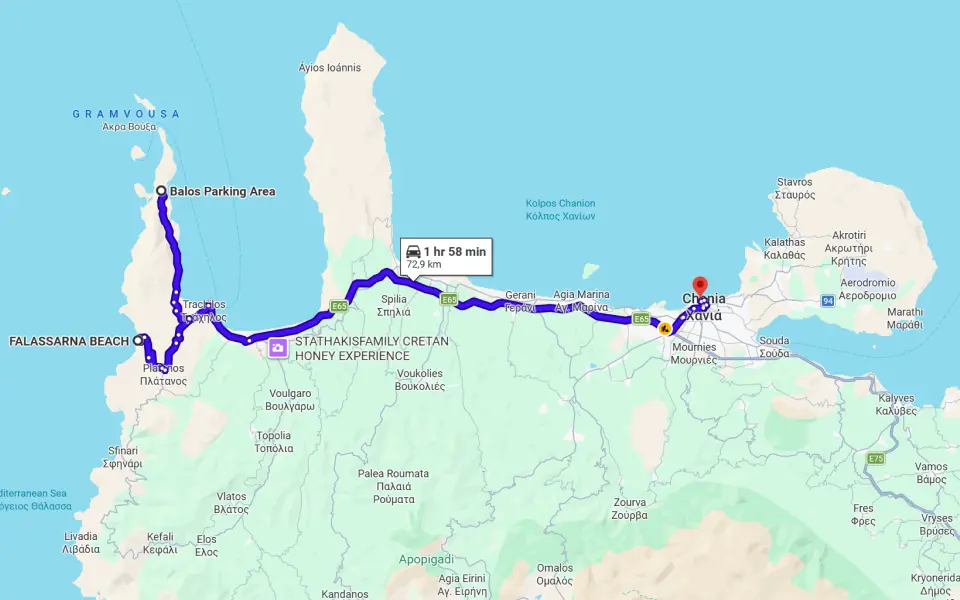
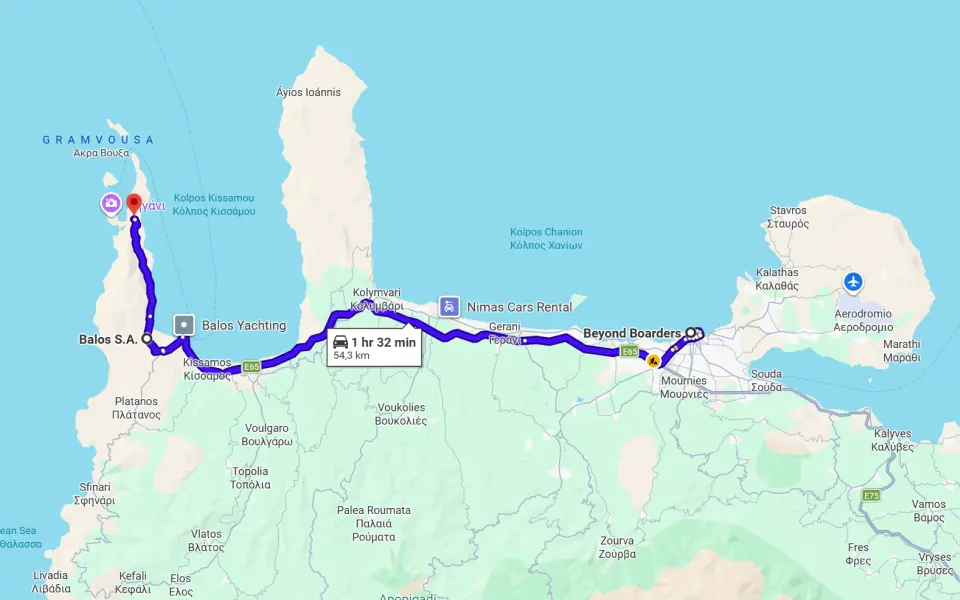
Open return route via Falasarna
Sort this out before you leave
The last seven kilometres to the car park are unpaved. Ruts, washboard, rocks, passing points barely wide enough for one car, and a long drop to the sea on the right. In summer, hatchbacks make it through — the road itself isn’t the problem. The problem is what your rental agreement says.
Most car hire companies in Crete prohibit driving on unpaved roads. The clause is usually buried in the terms rather than mentioned at key handover, and people tend to find it after something has already gone wrong. If your car is damaged on a dirt road, CDW insurance doesn’t apply — you pay for the repair in full, out of pocket. Not edge-case scenarios: a puncture, a cracked sump guard, a scraped bumper on a tight passing point.
Three options, and the right time to choose is before you book — not at the start of the track.
Book with a company that permits unpaved roads. The most straightforward route. The condition shows up when you select a specific car, so there are no surprises on the way.
Hire a crossover with extended cover. More expensive, but it covers both the ground clearance and the excess in one go. Worth it if Balos is a definite rather than a maybe.
Leave the car in Kissamos and take the boat. The ferry calls at Gramvousa island and its Venetian fortress, but it takes most of the day and ties you to a schedule. Your rental agreement stays untouched.
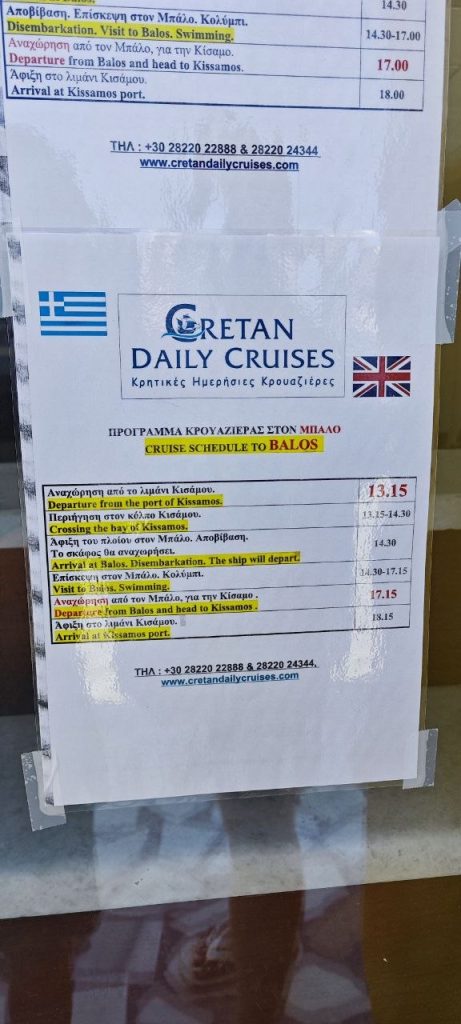
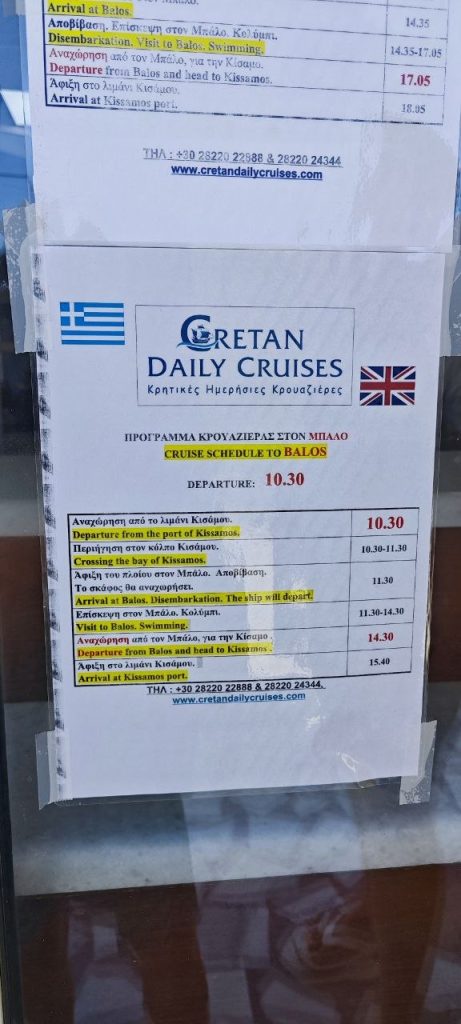
Four-wheel drive is not needed in any of these scenarios. What matters is ground clearance and the wording of your contract — in that order.
Find a car with unpaved road cover
The drive
Leave at eight. Not because of traffic — there’s almost none on this road — but because of the hike back up. The trail is fully exposed, with no shade at all, and at two in the afternoon it’s a different proposition entirely from ten in the morning.
The highway to Kissamos is straightforward. After Kissamos the road turns towards Kaliviani, the last village with tarmac. Beyond it, the surface ends and the dirt track begins — the one that runs along the Gramvousa Peninsula. Drive it slowly, twenty to thirty kilometres an hour, and don’t think of that as lost time: the views from this road are half the reason to come. Scorched hillside to the left, a sheer drop and water to the right in a shade that doesn’t quite exist in photographs. Note that there’s a 5 euro per car fee at the entrance — treat it as a national park charge.
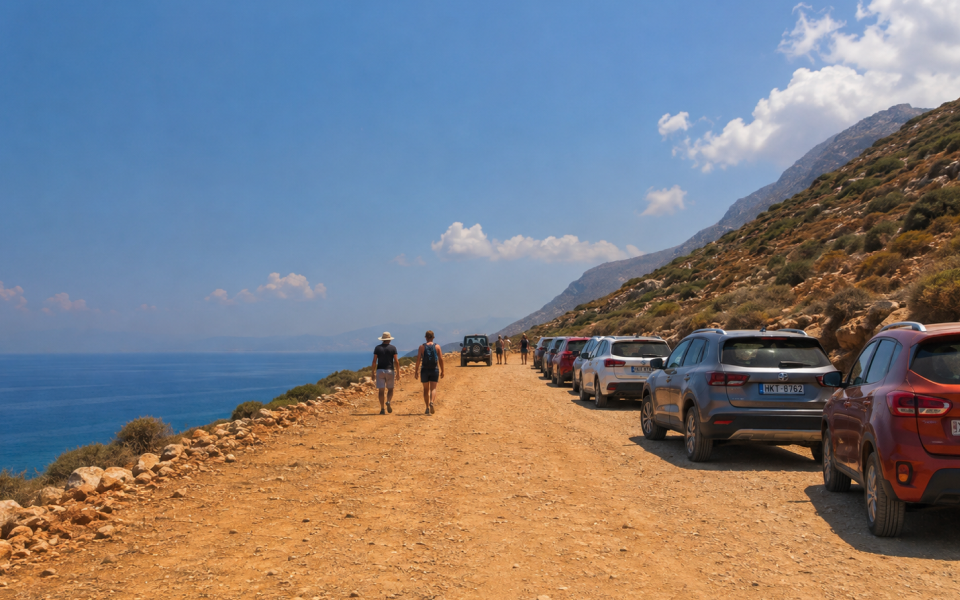
The road ends at a gate and a car park. Beyond that, nothing gets through.
Parking costs 3–5 euros, cash only — no ATM nearby, so have small notes ready. The toilets are paid separately, another euro. The perimeter fence isn’t there to keep people out; it’s there to keep the goats in. They roam in herds and have a detailed understanding of tourist rucksacks.
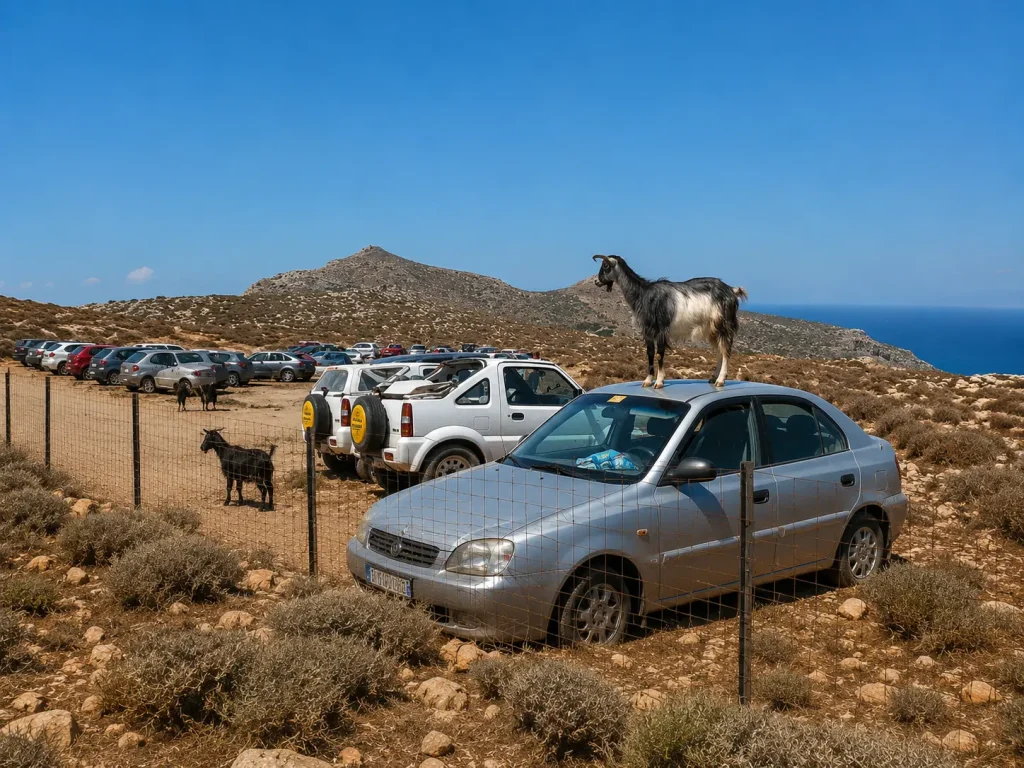
The descent
A rocky trail leads from the car park to the lagoon — stone steps, some broken. The way down takes twenty to thirty minutes and is straightforward. The way back up takes forty, and this is the one moment in the route where it’s worth being honest with yourself in advance. If you’re travelling with elderly relatives or very young children, the boat from Kissamos isn’t a compromise — it’s the right call.
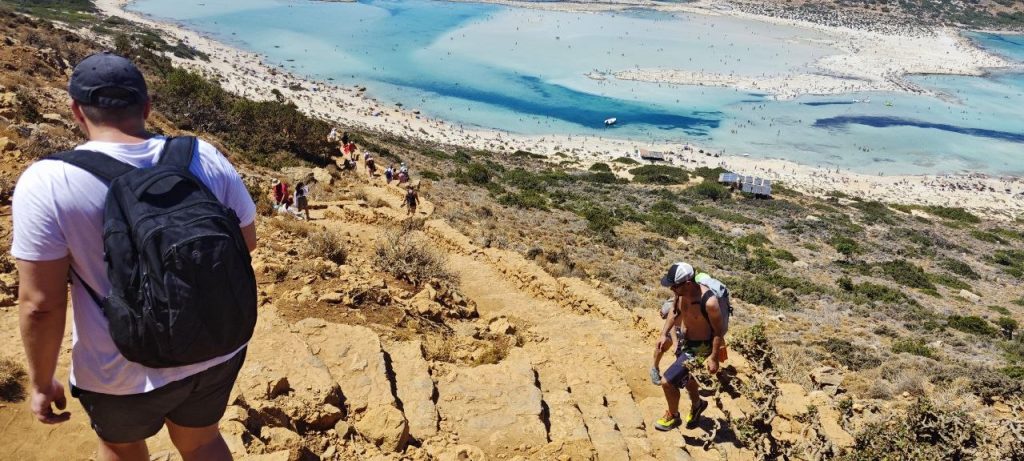
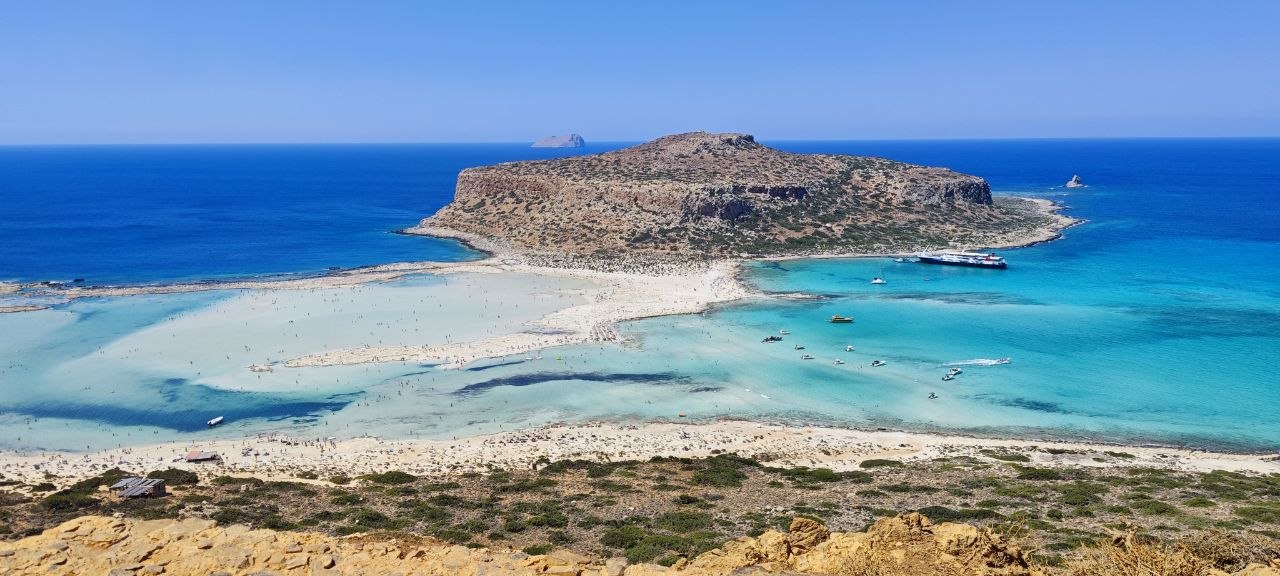
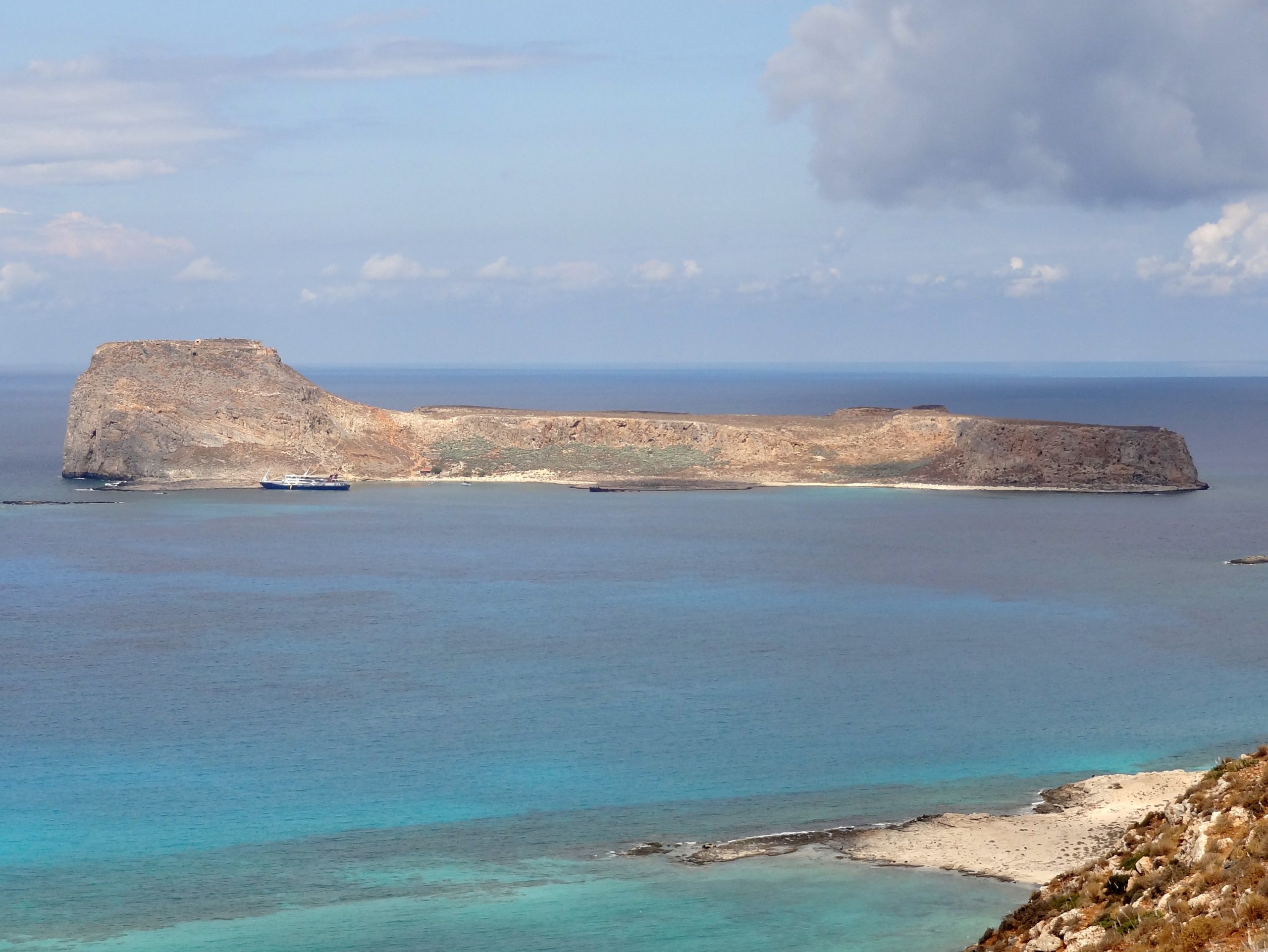
About halfway down there’s a viewpoint. The trail passes directly through it, no detour needed, but this is where the photograph happens: the turquoise shallows, the white sandbar, the dark outline of Gramvousa on the horizon. From the beach you’re inside the picture; this is the only place you can see it whole.
Closed shoes. In sandals, the descent becomes an exercise in itself and the climb back up becomes a test.
The lagoon
Balos isn’t a beach in the usual sense — it’s a shallow bowl of water between the mainland and a sand spit. The depth stays around knee-height for hundreds of metres from the shore, and the water warms up more than the open sea does. The result is a paradox: the hardest place on the island to reach turns out to be ideal for families with young children.
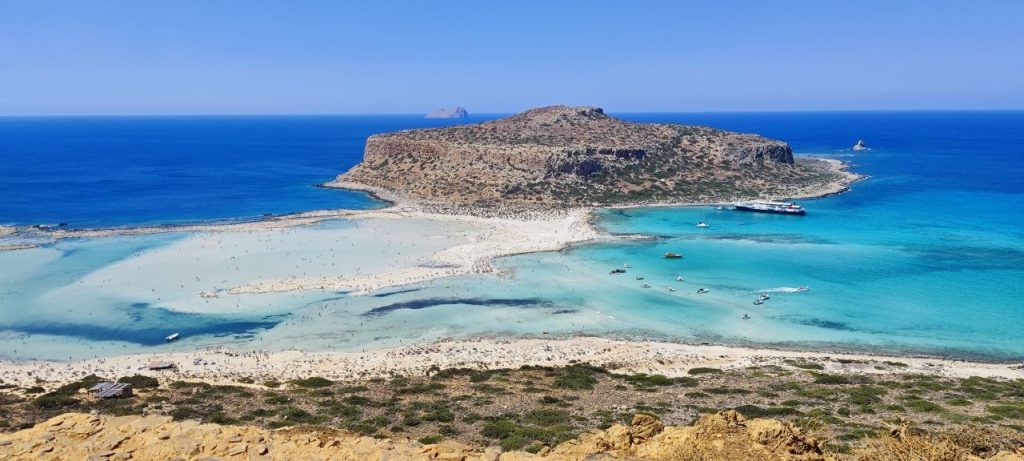
The pinkish tint of the sand comes not from any mineral but from crushed shells ground to powder. It’s not visible everywhere or at all times — most pronounced at the waterline, which is also where everyone stands with their phones.
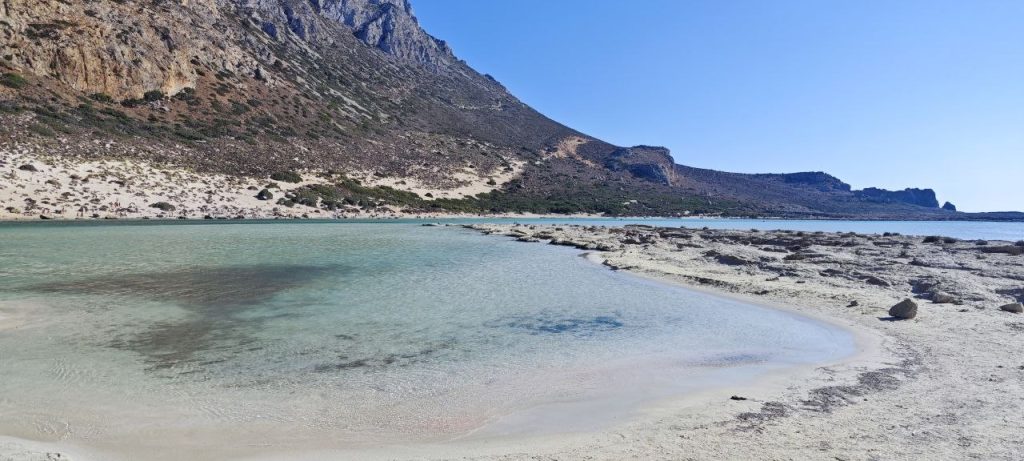
No shade. A parasol or a light cover works better than sunscreen here. Bring water from Chania; there’s some available at the beach but it costs more and isn’t always in stock. Keep food in your bag — the goats come down here too, and an open packet is an invitation.
Wind on this edge of the island is stronger than on the north coast. When the Meltemi is blowing hard, the lagoon loses its clarity and becomes ordinary turbid shallows, so check the forecast the night before.
A bit of history
The rock facing the lagoon is crowned by a Venetian fortress, built in the late sixteenth century against the Ottoman fleet, about 130 metres above sea level. The empire eventually left; the fortress stayed. In the 1820s, Greek pirates based themselves here and raided ships across the eastern Mediterranean. You can only reach it by boat; from the beach it’s a silhouette on the horizon.
The entire peninsula sits within a Natura 2000 protected zone. The absence of infrastructure on the beach is not an oversight — it’s the terms of the designation, which is also why there are no hotels, no tarmac, and no plans for either.
In 365 AD, an earthquake lifted the entire western end of Crete several metres in one event. The ancient port of Falasarna, which you can stop at on the way back, has been on dry land ever since: the stone-cut moorings sit a hundred metres from the water with grass growing between them.
The return
By one o’clock you’re back at the car, and the day has barely started. There’s no reason to go straight back to Chania.
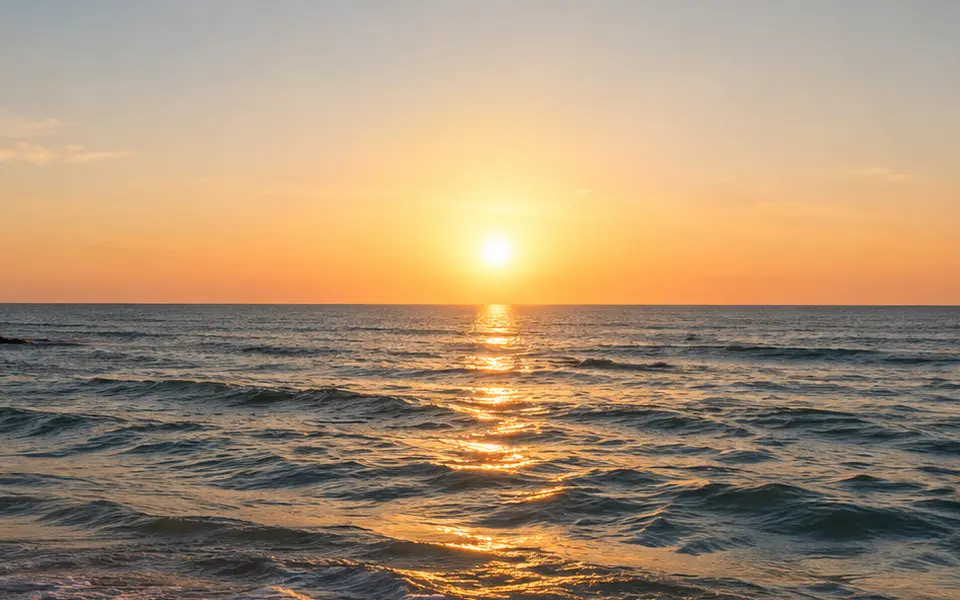
Falasarna is half an hour to the south: a wide sandy beach, tarmac all the way to the car park, and the best sunsets on the western coast. It’s the complete opposite of Balos — open, accessible, with proper facilities. After the morning’s descent and climb, the contrast is physical.
From there it’s an hour back to Chania on the highway. You’ll be in time for dinner at the old Venetian harbour.
What about Elafonisi?
The second lagoon lies to the southwest, and there’s no direct road between it and Balos. Don’t try to fit them into the same day — that’s around two hundred kilometres with two mountain sections and two long hikes.
The better plan is a separate day trip from the same base in Chania. The road climbs into the mountains through the Topolia Gorge and chestnut villages; the last thirty kilometres are a narrow switchback where meeting a bus means reversing. A full day, but the drive is half the experience.
Frequently asked questions
Five to six hours in total: ninety minutes each way, plus the hike and time at the beach. It fits comfortably into the first half of the day, leaving the evening free.
Physically, yes — hatchbacks make it in summer. Legally, it depends on your contract: many companies prohibit unpaved roads, and insurance doesn’t apply if they do. Check the terms before you book.
No. What matters is ground clearance and whether the rental company permits unpaved roads under your contract.
About 20–30 minutes down from the car park and 35–45 minutes back up. The climb in the heat is harder than the descent — bring water.
The boat avoids the dirt road question and includes a stop at Gramvousa island, but it takes most of the day and runs to a fixed schedule. Driving, you arrive when you want, leave when you want, and can still fit something else in.
No — they’re at opposite ends of western Crete with no direct road between them. Two separate day trips from Chania make more sense: Balos is a half-day, Elafonisi is a full day.
Roughly April through October. In winter the dirt track washes out and the beach facilities don’t operate.
Cash only. Cards aren’t accepted and there’s no ATM nearby.
Route stops
- Chania Airport (CHQ) — car pick-up
- Chania Old Venetian Harbour — starting point
- Kaliviani — last village with tarmac
- Balos car park — end of the driving section
- Viewpoint — on the trail down
- Balos beach — on foot only
- Falasarna — optional, on the return
Open return route via Falasarna